Severe Weather Outlook
Hayley here - Do you want to see severe weather in your calendar?
* it's like an add-on for your digital calendar NOT a paper calendar
National Severe Weather Outlook for the next week
Here you'll find all available severe weather outlooks on one page.
Overview of the threat for the next few days
Outlook for Tuesday, October 27
Outlook Summary
Isolated severe thunderstorms are possible for a few more hours this evening across a small portion of Far West Texas.
Outlook Images
overview

tornado low

wind low

hail 5%

Detailed Outlook
← back to overviewSPC AC 280059
Day 1 Convective Outlook NWS Storm Prediction Center Norman OK 0759 PM CDT Tue Oct 27 2026
Valid 280100Z - 281200Z
THERE IS A MARGINAL RISK OF SEVERE THUNDERSTORMS ACROSS PORTIONS OF FAR WEST TEXAS
### SUMMARY
Isolated severe thunderstorms are possible for a few more hours this evening across a small portion of Far West Texas.
Discussion
A remaining storm or two could pose an isolated large hail threat for the next few hours before weakening with the loss of daytime heating. Will maintain the Marginal Risk for this short term threat, but the severe weather threat will be minimal for the remainder of the overnight period.
..Bentley.. 10/28/2026
CLICK TO GET WUUS01 PTSDY1 PRODUCT
NOTE: THE NEXT DAY 1 OUTLOOK IS SCHEDULED BY 0600Z
Outlook for Wednesday, October 28
Outlook Summary
Isolated severe thunderstorms are possible over the Upper Mississippi Valley on Wednesday.
Outlook Images
overview

tornado 2%

wind 5%

hail 5%

Detailed Outlook
← back to overviewSPC AC 271730
Day 2 Convective Outlook NWS Storm Prediction Center Norman OK 1230 PM CDT Tue Oct 27 2026
Valid 281200Z - 291200Z
THERE IS A MARGINAL RISK OF SEVERE THUNDERSTORMS FOR PARTS OF THE UPPER MISSISSIPPI VALLEY
### SUMMARY
Isolated severe thunderstorms are possible over the Upper Mississippi Valley on Wednesday.
Synopsis
Broad mid-level troughing will encompass the upper air pattern over much of the CONUS on Wednesday, with a pronounced embedded impulse poised to traverse the northern Plains and impinge on the Upper MS Valley by late afternoon into early evening. The approach of this mid-level impulse will support rapid surface troughing over the Upper MS Valley, with some low-level moisture return expected. While buoyancy will be relatively weak, strong tropospheric flow accompanying the passing mid-level and surface troughs, along with adequate deep-layer ascent, will promote thunderstorm development over the Upper MS Valley by evening. There is some potential (albeit conditional) that a couple of these thunderstorms may become severe.
Upper MS Valley
As the surface trough intensifies through the day, a narrow ribbon of 60+ F surface dewpoints will advect northward ahead of the trough, beneath 7+ C/km mid-level lapse rates, contributing to 500-1000 J/kg MLCAPE. Furthermore, the strengthening of the surface trough will also encourage the development of a 40+ kt south-southwesterly low-level jet just before sunset, when buoyancy should be relatively maximized. Considerable veering and strengthening flow fields with height will support enlarged and curved low-level hodographs, especially closer to a warm front along the MN/WI border.
The vertical shear profile and expected MLCAPE magnitudes would certainly support supercells capable of producing all severe hazards. However, potential cloud cover may inhibit robust boundary-layer heating, and some MLCINH may linger just above the boundary layer as well. Therefore, any surface-based severe potential that can materialize will be highly dependent on stronger surface heating and subsequent CIN erosion. Still, at least some elevated buoyancy may be realized in the absence of stronger surface heating, so thunderstorms forced along the lee trough/cold front may still be accompanied by a hail threat.
..Squitieri.. 10/27/2026
CLICK TO GET WUUS02 PTSDY2 PRODUCT
NOTE: THE NEXT DAY 2 OUTLOOK IS SCHEDULED BY 0600Z
Outlook for Thursday, October 29
Outlook Summary
Severe thunderstorms are not expected on Thursday.
Outlook Images
overview

any severe low

Detailed Outlook
← back to overviewSPC AC 271911
Day 3 Convective Outlook NWS Storm Prediction Center Norman OK 0211 PM CDT Tue Oct 27 2026
Valid 291200Z - 301200Z
NO SEVERE THUNDERSTORM AREAS FORECAST
### SUMMARY
Severe thunderstorms are not expected on Thursday.
Synopsis
An upper ridge will build over the CONUS east of the Rockies while a mid-level trough amplifies over the Pacific Northwest on Thursday. Surface high pressure and accompanying subsidence will limit thunderstorm development over most places east of the MS River and over the Intermountain West. However, weak surface troughing and subsequent low-level moisture return will promote some thunderstorm potential over the central and southern Plains within a warm-air advection regime. A couple of thunderstorms are also possible over portions of the FL Peninsula given the presence of a warm, moist boundary layer. Lastly, a couple of lightning flashes are possible along the shoreline of the Pacific Northwest late Thursday night into early Friday morning. However, buoyancy appears too scant to support enough lightning coverage for the introduction of a General Risk area.
..Squitieri.. 10/27/2026
CLICK TO GET WUUS03 PTSDY3 PRODUCT
NOTE: THE NEXT DAY 3 OUTLOOK IS SCHEDULED BY 0730Z
Outlook for Friday, October 30
Outlook Images
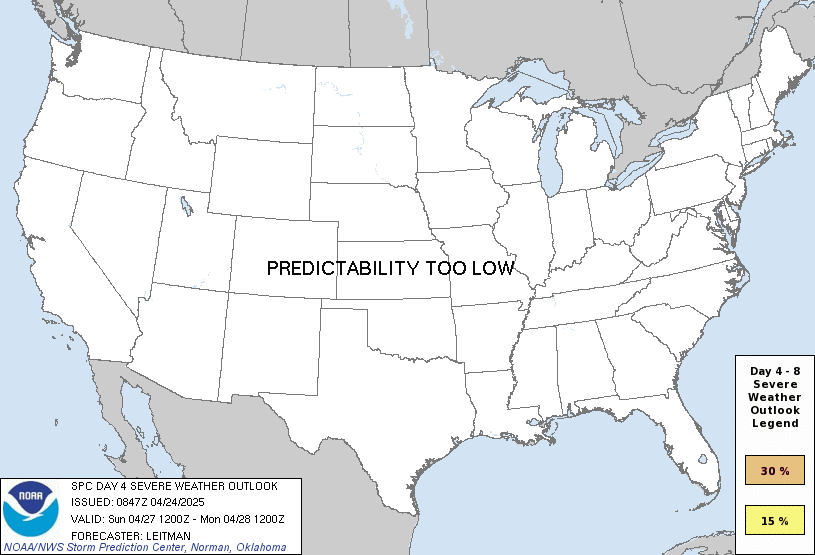
any severe potential too low
Note on Medium Range Outlooks
You are looking at an outlook that is part of the medium range forecast (the outlook for days 4-8). The most important thing to note is that lack of a risk does not mean zero risk. Generally speaking, confidence has to be pretty high for the Storm Prediction Center to have an outlook area this far into the future.
When no specific risk areas are shown, you might see one of these phrases:
- Predictability Too Low: This means that severe storms might be possible, but forecasters aren't confident enough about where or when they might occur. Think of it as the models showing different possibilities, like pieces of a puzzle that haven't come together yet.
- Potential Too Low: This means forecasters are fairly confident that widespread severe weather is NOT expected on that day. While isolated storms might still occur, the chance of reaching severe criteria across any given area is very low.
If you bookmark this page, it will continue to update with each new outlook that is issued.
Days Covered in this Outlook
| Day 4 | Friday, October 30 | potential too low |
| Day 5 | Saturday, October 31 | potential too low |
| Day 6 | Sunday, November 1 | potential too low |
| Day 7 | Monday, November 2 | predictability too low |
| Day 8 | Tuesday, November 3 | predictability too low |
Detailed Outlook
← back to overviewZCZC SPCSWOD48 ALL ACUS48 KWNS 270743 SPC AC 270743
Day 4-8 Convective Outlook NWS Storm Prediction Center Norman OK 0243 AM CDT Tue Oct 27 2026
Valid 301200Z - 041200Z
DISCUSSION
Severe potential appears low through Day 6/Sunday. Periods of thunderstorms are possible from the southern/central Plains to the Lower OH and TN Valleys during this time as a weak midlevel shortwave trough slowly migrates east within a modest deep-layer flow regime.
Medium-range forecast guidance suggests a deepening upper cyclone and attendant trough will emerge from the western U.S. into the Plains and Mid/Lower MS Valley vicinity Days 7-8/Monday-Tuesday. Increasing southerly low-level flow via deepening surface cyclogenesis will foster northward transport of rich Gulf moisture ahead of an eastward-advancing cold front. Despite increasing moisture, current forecast guidance maintains only modest instability due to weak lapse rates and possible inhibition around 850-700 mb. This general pattern could support severe thunderstorms depending on the evolution of the warm sector. However, uncertainty is high due to large spread among forecast guidance in the placement and timing of the upper trough. Trends will be monitored for increasing severe potential across the south-central U.S. early next week.
..Leitman.. 10/27/2026
CLICK TO GET WUUS48 PTSD48 PRODUCT
Outlook for Saturday, October 31
Outlook Images
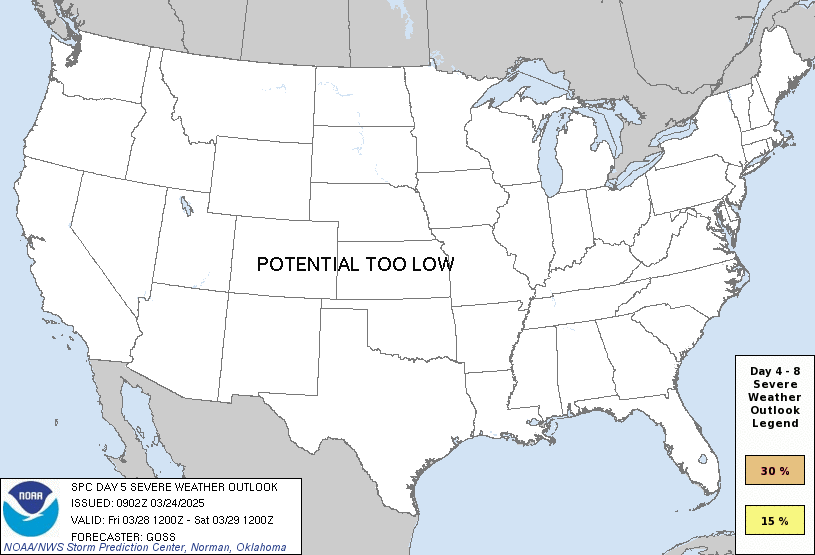
any severe potential too low
Note on Medium Range Outlooks
You are looking at an outlook that is part of the medium range forecast (the outlook for days 4-8). The most important thing to note is that lack of a risk does not mean zero risk. Generally speaking, confidence has to be pretty high for the Storm Prediction Center to have an outlook area this far into the future.
When no specific risk areas are shown, you might see one of these phrases:
- Predictability Too Low: This means that severe storms might be possible, but forecasters aren't confident enough about where or when they might occur. Think of it as the models showing different possibilities, like pieces of a puzzle that haven't come together yet.
- Potential Too Low: This means forecasters are fairly confident that widespread severe weather is NOT expected on that day. While isolated storms might still occur, the chance of reaching severe criteria across any given area is very low.
If you bookmark this page, it will continue to update with each new outlook that is issued.
Days Covered in this Outlook
| Day 4 | Friday, October 30 | potential too low |
| Day 5 | Saturday, October 31 | potential too low |
| Day 6 | Sunday, November 1 | potential too low |
| Day 7 | Monday, November 2 | predictability too low |
| Day 8 | Tuesday, November 3 | predictability too low |
Detailed Outlook
← back to overviewZCZC SPCSWOD48 ALL ACUS48 KWNS 270743 SPC AC 270743
Day 4-8 Convective Outlook NWS Storm Prediction Center Norman OK 0243 AM CDT Tue Oct 27 2026
Valid 301200Z - 041200Z
DISCUSSION
Severe potential appears low through Day 6/Sunday. Periods of thunderstorms are possible from the southern/central Plains to the Lower OH and TN Valleys during this time as a weak midlevel shortwave trough slowly migrates east within a modest deep-layer flow regime.
Medium-range forecast guidance suggests a deepening upper cyclone and attendant trough will emerge from the western U.S. into the Plains and Mid/Lower MS Valley vicinity Days 7-8/Monday-Tuesday. Increasing southerly low-level flow via deepening surface cyclogenesis will foster northward transport of rich Gulf moisture ahead of an eastward-advancing cold front. Despite increasing moisture, current forecast guidance maintains only modest instability due to weak lapse rates and possible inhibition around 850-700 mb. This general pattern could support severe thunderstorms depending on the evolution of the warm sector. However, uncertainty is high due to large spread among forecast guidance in the placement and timing of the upper trough. Trends will be monitored for increasing severe potential across the south-central U.S. early next week.
..Leitman.. 10/27/2026
CLICK TO GET WUUS48 PTSD48 PRODUCT
Outlook for Sunday, November 1
Outlook Images
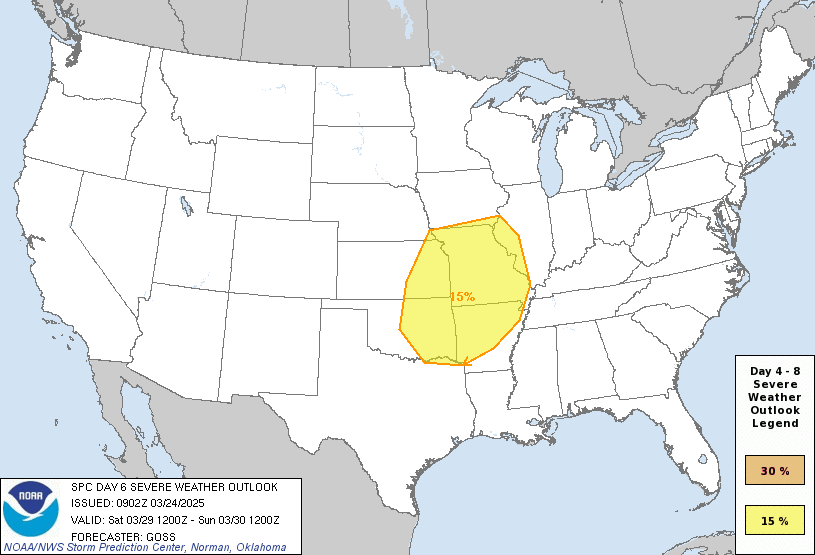
any severe potential too low
Note on Medium Range Outlooks
You are looking at an outlook that is part of the medium range forecast (the outlook for days 4-8). The most important thing to note is that lack of a risk does not mean zero risk. Generally speaking, confidence has to be pretty high for the Storm Prediction Center to have an outlook area this far into the future.
When no specific risk areas are shown, you might see one of these phrases:
- Predictability Too Low: This means that severe storms might be possible, but forecasters aren't confident enough about where or when they might occur. Think of it as the models showing different possibilities, like pieces of a puzzle that haven't come together yet.
- Potential Too Low: This means forecasters are fairly confident that widespread severe weather is NOT expected on that day. While isolated storms might still occur, the chance of reaching severe criteria across any given area is very low.
If you bookmark this page, it will continue to update with each new outlook that is issued.
Days Covered in this Outlook
| Day 4 | Friday, October 30 | potential too low |
| Day 5 | Saturday, October 31 | potential too low |
| Day 6 | Sunday, November 1 | potential too low |
| Day 7 | Monday, November 2 | predictability too low |
| Day 8 | Tuesday, November 3 | predictability too low |
Detailed Outlook
← back to overviewZCZC SPCSWOD48 ALL ACUS48 KWNS 270743 SPC AC 270743
Day 4-8 Convective Outlook NWS Storm Prediction Center Norman OK 0243 AM CDT Tue Oct 27 2026
Valid 301200Z - 041200Z
DISCUSSION
Severe potential appears low through Day 6/Sunday. Periods of thunderstorms are possible from the southern/central Plains to the Lower OH and TN Valleys during this time as a weak midlevel shortwave trough slowly migrates east within a modest deep-layer flow regime.
Medium-range forecast guidance suggests a deepening upper cyclone and attendant trough will emerge from the western U.S. into the Plains and Mid/Lower MS Valley vicinity Days 7-8/Monday-Tuesday. Increasing southerly low-level flow via deepening surface cyclogenesis will foster northward transport of rich Gulf moisture ahead of an eastward-advancing cold front. Despite increasing moisture, current forecast guidance maintains only modest instability due to weak lapse rates and possible inhibition around 850-700 mb. This general pattern could support severe thunderstorms depending on the evolution of the warm sector. However, uncertainty is high due to large spread among forecast guidance in the placement and timing of the upper trough. Trends will be monitored for increasing severe potential across the south-central U.S. early next week.
..Leitman.. 10/27/2026
CLICK TO GET WUUS48 PTSD48 PRODUCT
Outlook for Monday, November 2
Outlook Images
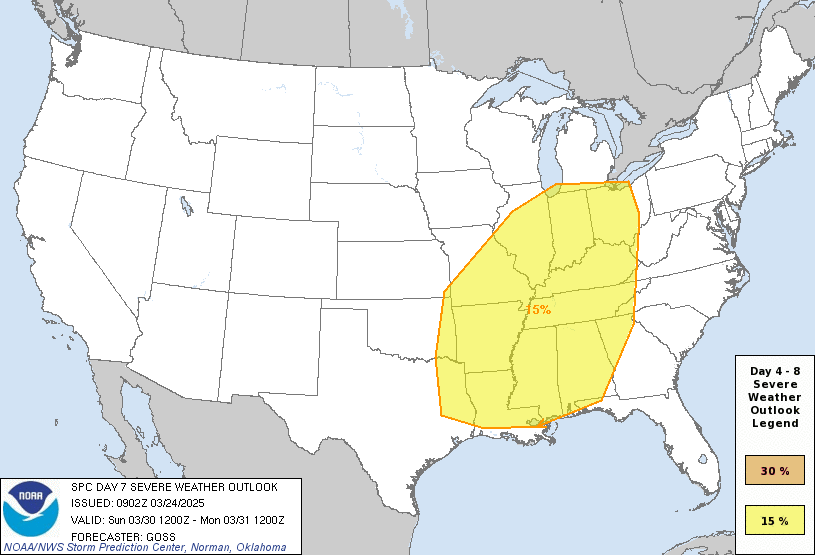
any severe predictability too low
Note on Medium Range Outlooks
You are looking at an outlook that is part of the medium range forecast (the outlook for days 4-8). The most important thing to note is that lack of a risk does not mean zero risk. Generally speaking, confidence has to be pretty high for the Storm Prediction Center to have an outlook area this far into the future.
When no specific risk areas are shown, you might see one of these phrases:
- Predictability Too Low: This means that severe storms might be possible, but forecasters aren't confident enough about where or when they might occur. Think of it as the models showing different possibilities, like pieces of a puzzle that haven't come together yet.
- Potential Too Low: This means forecasters are fairly confident that widespread severe weather is NOT expected on that day. While isolated storms might still occur, the chance of reaching severe criteria across any given area is very low.
If you bookmark this page, it will continue to update with each new outlook that is issued.
Days Covered in this Outlook
| Day 4 | Friday, October 30 | potential too low |
| Day 5 | Saturday, October 31 | potential too low |
| Day 6 | Sunday, November 1 | potential too low |
| Day 7 | Monday, November 2 | predictability too low |
| Day 8 | Tuesday, November 3 | predictability too low |
Detailed Outlook
← back to overviewZCZC SPCSWOD48 ALL ACUS48 KWNS 270743 SPC AC 270743
Day 4-8 Convective Outlook NWS Storm Prediction Center Norman OK 0243 AM CDT Tue Oct 27 2026
Valid 301200Z - 041200Z
DISCUSSION
Severe potential appears low through Day 6/Sunday. Periods of thunderstorms are possible from the southern/central Plains to the Lower OH and TN Valleys during this time as a weak midlevel shortwave trough slowly migrates east within a modest deep-layer flow regime.
Medium-range forecast guidance suggests a deepening upper cyclone and attendant trough will emerge from the western U.S. into the Plains and Mid/Lower MS Valley vicinity Days 7-8/Monday-Tuesday. Increasing southerly low-level flow via deepening surface cyclogenesis will foster northward transport of rich Gulf moisture ahead of an eastward-advancing cold front. Despite increasing moisture, current forecast guidance maintains only modest instability due to weak lapse rates and possible inhibition around 850-700 mb. This general pattern could support severe thunderstorms depending on the evolution of the warm sector. However, uncertainty is high due to large spread among forecast guidance in the placement and timing of the upper trough. Trends will be monitored for increasing severe potential across the south-central U.S. early next week.
..Leitman.. 10/27/2026
CLICK TO GET WUUS48 PTSD48 PRODUCT
Outlook for Tuesday, November 3
Outlook Images
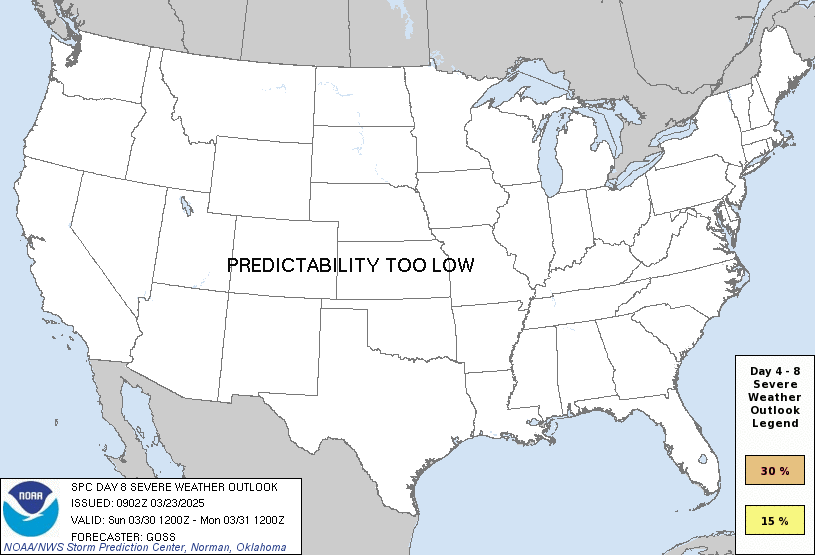
any severe predictability too low
Note on Medium Range Outlooks
You are looking at an outlook that is part of the medium range forecast (the outlook for days 4-8). The most important thing to note is that lack of a risk does not mean zero risk. Generally speaking, confidence has to be pretty high for the Storm Prediction Center to have an outlook area this far into the future.
When no specific risk areas are shown, you might see one of these phrases:
- Predictability Too Low: This means that severe storms might be possible, but forecasters aren't confident enough about where or when they might occur. Think of it as the models showing different possibilities, like pieces of a puzzle that haven't come together yet.
- Potential Too Low: This means forecasters are fairly confident that widespread severe weather is NOT expected on that day. While isolated storms might still occur, the chance of reaching severe criteria across any given area is very low.
If you bookmark this page, it will continue to update with each new outlook that is issued.
Days Covered in this Outlook
| Day 4 | Friday, October 30 | potential too low |
| Day 5 | Saturday, October 31 | potential too low |
| Day 6 | Sunday, November 1 | potential too low |
| Day 7 | Monday, November 2 | predictability too low |
| Day 8 | Tuesday, November 3 | predictability too low |
Detailed Outlook
← back to overviewZCZC SPCSWOD48 ALL ACUS48 KWNS 270743 SPC AC 270743
Day 4-8 Convective Outlook NWS Storm Prediction Center Norman OK 0243 AM CDT Tue Oct 27 2026
Valid 301200Z - 041200Z
DISCUSSION
Severe potential appears low through Day 6/Sunday. Periods of thunderstorms are possible from the southern/central Plains to the Lower OH and TN Valleys during this time as a weak midlevel shortwave trough slowly migrates east within a modest deep-layer flow regime.
Medium-range forecast guidance suggests a deepening upper cyclone and attendant trough will emerge from the western U.S. into the Plains and Mid/Lower MS Valley vicinity Days 7-8/Monday-Tuesday. Increasing southerly low-level flow via deepening surface cyclogenesis will foster northward transport of rich Gulf moisture ahead of an eastward-advancing cold front. Despite increasing moisture, current forecast guidance maintains only modest instability due to weak lapse rates and possible inhibition around 850-700 mb. This general pattern could support severe thunderstorms depending on the evolution of the warm sector. However, uncertainty is high due to large spread among forecast guidance in the placement and timing of the upper trough. Trends will be monitored for increasing severe potential across the south-central U.S. early next week.
..Leitman.. 10/27/2026
CLICK TO GET WUUS48 PTSD48 PRODUCT
National Risk Overview
- Tuesday, October 27
- TORNADO: low
- HAIL: 5%
- WIND: low
- Wednesday, October 28
- TORNADO: 2%
- HAIL: 5%
- WIND: 5%
- Thursday, October 29
- ANY SEVERE: low
- Friday, October 30
- ANY SEVERE: potential too low
- Saturday, October 31
- ANY SEVERE: potential too low
- Sunday, November 1
- ANY SEVERE: potential too low
- Monday, November 2
- ANY SEVERE: predictability too low
- Tuesday, November 3
- ANY SEVERE: predictability too low
Your Severe Outlook
Hey, it looks like your location wasn't detected.
Drag the marker on the map and we'll show you the severe weather potential for a given location.
Hi, I'm Hayley. Did you know that I run this site out of my own pocket? So if you'd like to help out and you're already planning on buying something off of Amazon, why not use our Amazon Severe Weather Outlook link before you buy and we'll get a tiny portion of your purchase.
About Severe Weather Outlook . com
SWO started as a spinoff project of wickedwx, but has since replaced the site.
- tornado hq - live severe weather warnings
- cyclocane - hurricanes/typhoons/cyclones
- tornado solitaire - play cards while you monitor the US severe weather threat
- tertremo - live view of earthquakes around the world
- earthquake solitaire - get live earthquake updates as you play your favorite card game